Introduction to epidemiology
Learning objectives
- Define epidemiology
- Describe basic terminology and concepts of epidemiology
- Describe epidemiological study designs
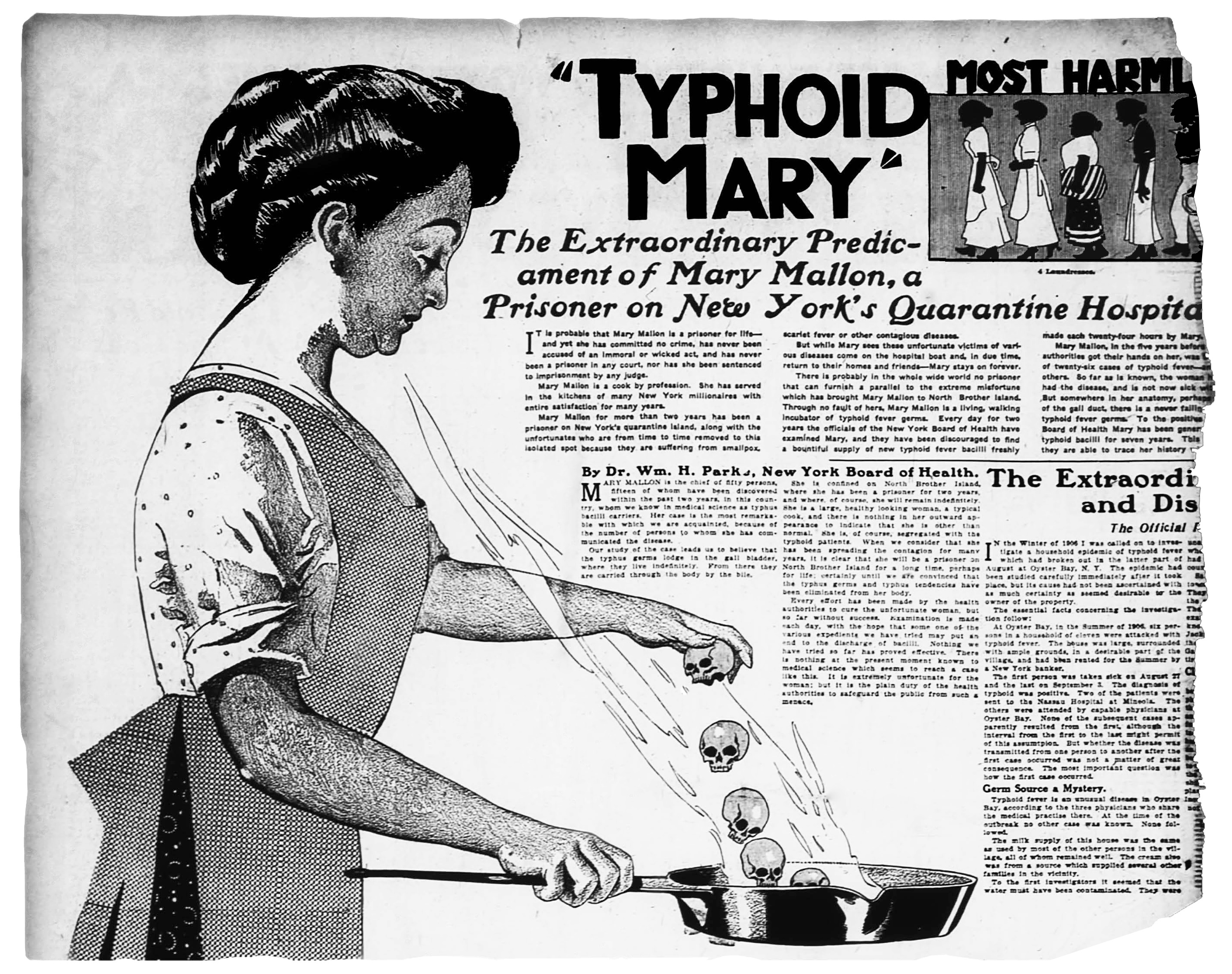
Mary Mallon
“I never had typhoid in my life, and have always been healthy. Why should I be chased like a convicted criminal?”
— Mary Mallon
- Linked to 51 typhoid indfection and 3 deaths in early 1900s.
- Mary was a asymptomatic carrier.
- Transforming modern epidemiological tracking, quarantine, and medical ethics.
What is epidemiology?
Definition
Study of the distribution and determinants of health-related states among specified populations and the application of that study to the control of health problems.
Some common questions that epidemiologists ask include:
- Who gets sick?
- When do they get sick?
- Where do they get sick?
- How do they get sick?
- Why do they get sick?
- How can we prevent them from getting sick?
Getting disease descriptions
- Case study
- Common tools: Interview with case
- Purpose: In depth investigate the disease process and identify potential causes and risk factors.
- Cross-sectional study
- Common tools: Survey (one single time)
- Purpose: Assess the prevalence of disease and its association with potential risk factors at certain time.
- Ecological study
- Common tools: health records, government statistics
- Purpose: Population level to assess the trend, association of a disease.
Key measures in epidemiology
- Prevalence ≈ how common the disease is right now in a group
- Incidence ≈ how many new cases appear over a period of time
- Relative risk (RR) ≈ “how many times more (or less) risk if exposed?”
- RR = 1 → same risk;
- RR > 1 → higher risk in exposed;
- RR < 1 → lower risk
- Odds ratio (OR) ≈
- Odds, measure the chance that a health event happens compared to the chance it does not happen (\(p/(1-p)\)) OR has the similar interpretation as RR
We will compute RR/OR in the next class.
Understand association
- Cohort study
- Common tools: health records, participant recruit (optional)
- Perspective: Control on the exposure and test the outcome is developed
- Case-control study
- Common tools: health records
- Perspective: Control on the outcome and test what exposure is associated with the outcome
Cohort study
Cohort
A group of people who share a common characteristic or experience within a defined period of time.
Idea
- Select a group of people (cohort)
- with shared similar characteristics (Age, sex, etc.)
- with different exposures (e.g., smoking vs. non-smoking)
- Follow them over time to see who develops the disease of interest (e.g., lung cancer).
Retrospective cohort study
Looking back from the history of the cohort to determine exposure status and outcome.
- Find out who were exposed and who were not exposed in the past.
- Find out who develops the disease of interest after the exposure.
Prospective cohort study
Enroll participants by exposure status now, then follow them forward over time to track who develops the outcome.
- Identify who are exposed and who are not exposed at the start of the study.
- Follow them forward to see who develops the disease of interest after enrollment.
Case control study
- We select a group of people with
- similar characteristics (e.g., age, sex)
- with different disease (e.g., cancer vs. non-cancer),
- Check what kind of exposure they had before the disease
Comparison
| Starting Point |
Exposure status |
Disease status (Outcome) |
| Direction of Inquiry |
Forward (Exposure → Outcome) |
Backward (Outcome → Exposure) |
| Primary Metric |
Relative Risk (RR) |
Odds Ratio (OR) |
| Ideal Use Case |
Rare exposures |
Rare diseases |
| Can measure incidence? |
Yes |
No |
Experimental epidemiology
Randomized controlled trial (RCT)
Idea
- Select a group of people with similar characteristics (e.g., age, sex)
- Randomly assign them to treatment (e.g., drug) or control (e.g.,placebo, reference point),
- Follow-up to see improvement in health outcomes to test the efficacy of the treatment.