AI watermarks
Paper reading on Kirchenbauer et al. 2023
AI Text Watermark
An AI text watermark is not a hidden character, a secret tag, or special file metadata. Instead, text watermarks are mathematical patterns in word choice
A brief explanation how LLM works
- Whenever an AI generates a sentence, it often has multiple words to pick next (e.g., choosing between quick, fast, or rapid).
- AI will choose a word based on words probability (Top-p/Top-K sampling)
A brief idea of AI watermark
- If I set rapid in the Watermark list, then AI-generated text will be in favor of choosing rapid over other synonyms
- If we have a bag of the Watermark list, as long as a “statistically significant” amount of the word occurs in the Watermark list then I will believe it is an AI-generated content
Challenges of developing watermarks
- Imperceptibility :
- Language conventions
- Content accuracy, highly technical writing
- Mathematical formula writing
- Robustness :
- Robust to reformatting, paraphrasing
- Detectability & Security :
- Low false positive rate, cannot reverse attack the algorithm
Generating watermarks
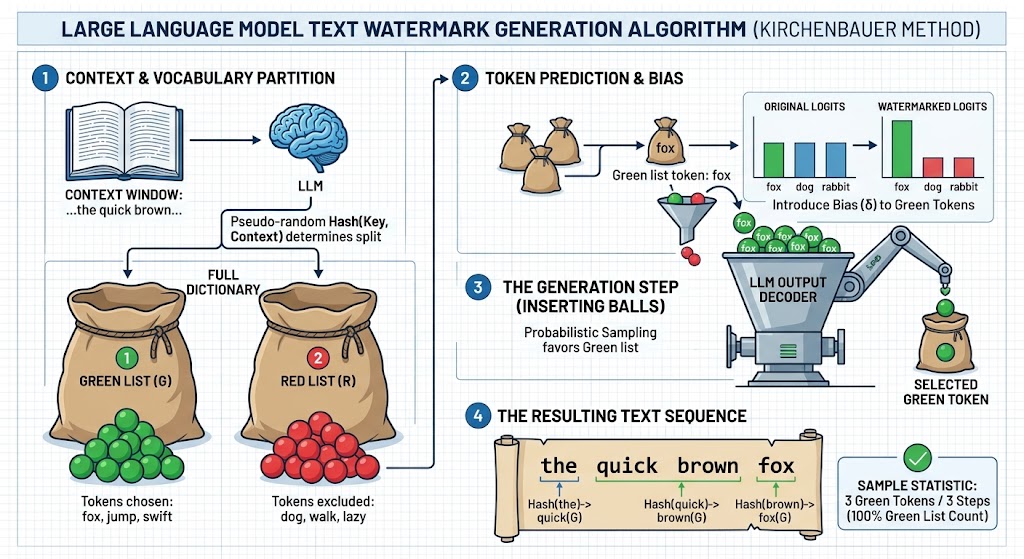
Before generating word: The AI looks at the word it just typed and uses a secret rule to secretly split the entire dictionary into 50% Green words and 50% Red words.
During generating words: The AI gives Green words a subtle extra boost (\(\delta\)), making them far more likely to be chosen while keeping the sentence completely natural.
Deciphering watermarks
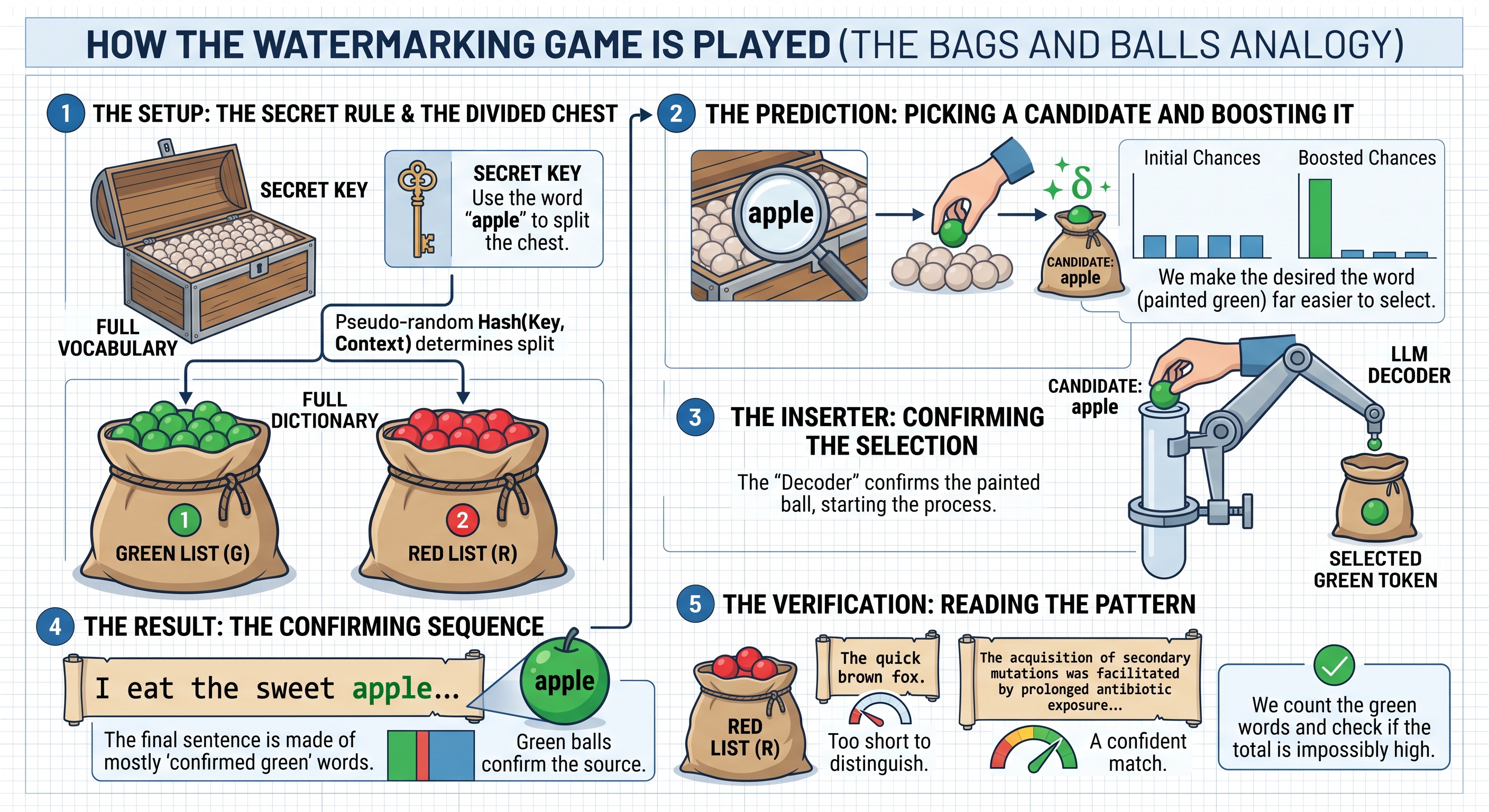
Detecting a text: A human naturally lands on Green about 50% of the time (like flipping a fair coin), but the watermarked AI lands on Green 75%–85% of the time.
The final judgement: If a 200-word paragraph hits Green far too often to be pure luck, a quick probability test proves it came from the AI.
Shortest detectable length for a watermark
Assuming a 50% (\(\gamma\)) Green/Red split
The Expectation of Z-test statistics given a sample of T tokens is: \[ \mathbb{E}[z] = \frac{(\bar{p}_G - \gamma)\sqrt{T}}{\sqrt{\gamma(1 - \gamma)}} \]
\(\bar{p}_G\) is the observed proportion of Green words in the sample, this rate is roughly controlled by how you set the watermarking strength (\(\delta\)).
In common settting we use the critial value of 3 (\(\tau\)) to determine if a text is watermarked or not.
We can plot how does \(\bar{p}_G\) vary with different sample sizes.
| Watermark Strength | Expected Green Rate (\(\bar{p}_G\)) | Minimum Detectable Sample Size (T) | Minimum Detectable Sample Size (Words) |
|---|---|---|---|
| Moderate Soft Watermark (\(\delta \approx 1.5\)) | \(\bar{p}_G \approx 0.70\) | \(\approx 100\) tokens (~75 words) | \(\approx 56\) tokens |
| Standard Soft Watermark (\(\delta \approx 2.0\)) | \(\bar{p}_G \approx 0.80\) | \(\approx 44\) tokens (~30–35 words) | \(\approx 25\) tokens |
| Aggressive Soft Watermark (\(\delta \ge 4.0\)) | \(\bar{p}_G \approx 0.90\) | \(\approx 25\) tokens (~18–20 words) | \(\approx 14\) tokens |
| Theoretical Limit: Hard Red List (\(\delta \to \infty\)) | \(\bar{p}_G = 1.0\) (100% Green) | \(16\) tokens | \(9\) tokens |
False Negative rate of the watermark detection
| Sequence Length (T) | False Negative Rate (\(\bar{p}_G \approx 0.70\)) | False Negative Rate (\(\bar{p}_G \approx 0.80\)) | False Negative Rate (\(\bar{p}_G \approx 0.90\)) |
|---|---|---|---|
| \(T = 25\) tokens (~18 words) | \(\approx 99.8\%\) (undetermined) | \(\approx 84.1%\) | \(\approx 15.9\%\) |
| \(T = 50\) tokens | \(\approx 92.3\%\) | \(\approx 10.6\%\) | \(\approx 0.02\%\) |
| \(T = 100\) tokens | \(\approx 50.0\%\) | \(\approx 0.03\%\) | \(< 10^{-6}\) |
| \(T = 200\) tokens | \(\approx 1.4\%\) | \(< 10^{-6}\) | \(\approx 0\) |
| \(T \ge 300\) tokens | \(\approx 0.003\%\) | \(\approx 0\) | \(\approx 0\) |
Preventing being flagged out
- Watermark algorithms calculate probabilities based on preceding word sequences.
- Merely replacing words with synonyms often preserves the underlying statistical graph.
- Instead, restructure clauses/Splitting:
- Break one long compound sentence into two punchy, short sentences.
- Turn passive clauses into active personal statements (“The experiment was concluded” -> “We wrapped up the trials on Friday”).
- Insert concrete examples, personal anecdotes, or unique domain terminology.
Cross-Model Paraphrasing
LLM1 -> “Watermarked” -> LLM2 -> “Unwatermarked”
Usually LLM2 will be some open-source model that is not watermarked, and it will paraphrase the text in a way that removes the watermark.
Laziest approach to avoid detection, but it can also introduce errors or change the meaning of the text.
Daily Life Implications
| Scenario | Watermark Risk | Real-World Impact |
|---|---|---|
| Brainstorming & Outlining | Zero | Ideas, bullet points, and high-level concepts carry no sentence-level token distribution. |
| Proofreading / Polishing your own draft | Negligible | If the ideas and majority of words are yours, the AI merely fixes grammar or word order. There is very little AI token sequence for a detector to latch onto. |
| Direct Generation (Copy-Pasting full drafts) | High | The text contains raw, continuous model token sequences that reliably trigger detection algorithms. |
Does free online AI watermark detector and remover work?
- Challenges for free detectors:
- Getting the private key that generated the green/red split is impossible
- Free detectors have to guess the watermarking strength and the green/red split.
- Easy way for most free online AI watermark detector and remover tools:
- Shallow heuristics or,
- Simple statistical tests
Watermarks on other modality
Text watermarking is not the only modality that can be watermarked. Other modalities include:
- Image watermarking
- Well-established field,
- Visible or hidden patterns embedded in the pixels of an image.
- Audio watermarking
- Similar to image watermarking, but applied to audio signals.
- Adding low-level noise or frequency patterns
Still text watermarking is more challenging due to the discrete nature of language and the need for semantic coherence.
Takeaways
- Simple paraphrasing or synonym replacement is not enough to remove watermarks.
- Restructuring sentences, adding personal anecdotes, and using unique domain terminology are more effective strategies
- Existing free online AI watermark detector and remover tools may not be reliable due to the lack of access to the private key and reliance on shallow heuristics or simple statistical tests.
Open Discussion: The Future of Provenance
- Where is the line? If an AI polishes your original draft into its own green-list vocabulary, is that original work or AI ghostwriting?
- The Enforcement Paradox: If tech-savvy users can easily wipe watermarks with open-source tools, who does watermarking actually protect?
- The Keyholder Dilemma: Should tech companies keep watermark keys private, or should verification tools be open to certain level that public can verify it?